



Genetics Australia Theme
Not many people can claim 1990s Saturday morning cartoons as the inspiration for a successful career in genetics…but Rick Schmidt can.
Mr Schmidt has been appointed as Genetics Australia’s Gippsland sales representative. He comes from a diverse background in sales and industrial sciences, most recently as a Key Account Manager for a chemical engineering company in the paper industry. His experiences also cover retail, hospitality, industrial laboratories, genetic research, and a little graphic design.
And it all stems from those oddball cartoons.
“Genetics has been a passion of mine since the early 90s, watching Saturday morning cartoons where every show was mixing this with that to create a super-whatever,” he said. “That later translated into video games doing much of the same and then into a passion for biology and how things work.”
Mr Schmidt started his career in groceries as a trolley pusher and worked his way up to duty manager while at high school and university before getting a taste of a working lab environment in a water chemistry lab.
He left university at 20 when his father passed away and focused on getting a career without a degree. Including managing a Good Guys store in Traralgon for five years, developing his customer service and sales skills.
Mr Schmidt later returned to Federation University to study a Bachelor of Science – Biotechnology while finding work in local laboratories, including a research lab and industrial labs in the dairy industry and later the paper industry.
Mr Schmidt says he’s up for the challenge of bridging the gap in his knowledge about farming.
“I don’t have any real farming experience,” he said. “My grandparents had a beef farm in Hazelwood Estate for several years but have since retired and sold up. I was too busy studying and working in my teenage years and missed out on the farming experience.”
But he’s keen to learn. “I have already learned so much about the industry and have only just started, but I have a solid foundation to build off and I look forward to the learning experience,” he said. “I get to use my skillsets in a new and interesting way while exploring the Gippsland region and get to help people do what they love in a field I have a lot of passion for.”
“I am here to help farmers and retailers with their unique needs from GA. I have a great team behind me with decades of experience who I can rely on for whatever may come up and I’m most looking forward to working with farmers and seeing the next generation of their herds.”
Genetics Australia CEO Anthony Shelly said Mr Schmidt would bring a high level of sales and account management skills to the role. “Rick has sold everything from groceries, fridges, beer, chooks and chemicals, so his sales skills are vast with some great achievements,” Mr Shelly said.
“He obtained a Bachelor of Science – Biotechnology and spent several years as a quality technician and lab supervisor in the dairy industry and as a visiting researcher in a Genomics Research Laboratory.
“He now has the stimulus to develop a deep understanding of the cattle breeding industry,” he said.
Mr Schmidt is based in Churchill and will cover the broader Gippsland region.
Click here to view PDF version of the article
Rob Derksen started his career in cattle breeding in 1973, at Victorian Artificial Breeders (VAB), where he first came into contact with the Jersey breed. Derksen has been employed by Genetics Australia (GA) since it was established in 1994. The Australian AI company maintains close contact with Jersey Australia and since 2023 is part of the URUS group. Jersey International spoke with the very experienced breeding man about the Jersey program at GA and the qualities of the Australian Jersey population.
To get an impression: how large is the Jersey population in Australia?
Derksen: ‘There are about 200,000 Jersey cows in Australia, and a few thousand more that have Jersey blood in the pedigree. Approximately 100,000 Jerseys are on official milk production recording.’
How extensive is the Jersey program at GA? How many sires are launched annually?
‘In the time before genomic testing, at VAB we sampled about 60 Jersey sires annually. Of course, the arrival of genomics has turned the entire system upside down. In the past, just 1,200-,1500 doses of a “young sire” were used. Nowadays, bulls that receive their first daughters in production are often surpassed by the quality of the available younger sires, so we no longer “sample” a certain number of sires. If I need to put a number on it, I would say that we annually launch about eight new sires in our program. In total, GA currently has 35 Jersey sires available, both progeny proven and young DNA-tested sires.’
What are the most significant traits used by GA for selecting Jersey bulls?
‘Our national breeding goal is the BPI (Balanced Performance Index). It is an economic index based on 51% production, 32% health and fertility, 11% conformation, and 6% milking speed, temperament, and farmer satisfaction. As such, BPI forms the foundation, but there are also other aspects that are taken into account. We give preference to sires with A2A2 and BB, and also pay attention to genetic defects and bloodlines.’
Does GA have its own female breeding program, or are all sires bred by Australian breeders?
‘No, we do not have our own breeding program but work closely with Australian breeders for generating our sires. For Holsteins, however, we have a connection with the Peak breeding program, and perhaps Jerseys will be added in the future.’
Does GA primarily acquire its genetics domestically, or also from abroad?
‘The reason why Australia is such a rich source of Jersey genetics lies in the readiness of Australian breeders to use the best sires from all over the world. In the past, Jersey bulls from New Zealand, the US, Denmark, and to a lesser extent Canada appeared in the pedigrees of sires. Sires need to especially score well for the Australian indexes. Some sires can breed nice cows, but if they are not high ranking in Australia, they will not be widely used. In recent years we have used more and more Australian sires for our breeding program, since it is becoming increasingly difficult to find suitable bulls from other Jersey programs. An exception to this is the American sire Valentino, who was marketed by GA.’
What are the most import qualities of Australian Jerseys? What sets them apart from other Jersey populations?
‘I do not want to become controversial here, but will provide a brief summary of the differences between Australian Jerseys and other sources. We are of the opinion that Australian Jerseys are generally more balanced in terms of production and conformation. And we do not use any JX sires (sires with non-Jersey bulls in the pedigree, BW), as they are not accepted very well here. All of our sires are fully registered in the Australian Jersey herdbook. We continue to use the best sires that score well here. We see that Australian Jerseys have a bit more milk and perform better for BPI and conformation than many Danish sires. That they have more dairyness and strength in the front end than the bulls currently available in the US (and we do not use JX sires). And that generally they provide better conformation than the available New Zealand sires. For that reason we also see increasing demand for Australian Jerseys in countries like New Zealand and the US.’
What makes the Australian Jersey population so strong?
‘Compared to other Jersey populations, Australian breeders have always embraced the best genetics worldwide to develop truly profitable cows and bulls that can compete internationally. In general, Danish and North American breeding organizations have used one another’s genetics, New Zealand has, generally speaking, only used its own genetics, while in Australia, you come across bloodlines from all of these populations, together with locally developed genetics. I think that no other country can claim to have done the same.’
Has the Australian Jersey cow changed much over the years?
‘Yes, since I first came into contact with the breed, today’s Jerseys have higher milk production without having lost the breed advantage of high components. In addition, udder quality and udder texture has improved, they have better rump width and angle, and in general they are a bit taller so that they can compete with other breeds.’
Are a lot of Australian Jersey genetics being marketed to other countries?
‘That is growing. I have already mentioned the US and New Zealand, but the growth potential is the greatest in Asian and African countries. During the past three years, we have exported Jersey semen to Pakistan, and during the past two years, also DNA-tested Jersey two-year-olds. In the coming year we hope to begin exporting Jersey semen to India (1.4 billion people – Pakistan, 230 million). These countries have a growing need to improve the productivity of their dairy herd. While buffalo milk is common and popular due to the extra creamy taste, Jersey milk is ideal to meet this need and to provide larger volumes of milk than the indigenous breeds. For more than fifteen years, South Africa has been the country with the largest semen import of Australian Jerseys, used for Jersey x Jersey and for crossbreeding programs, especially with Holstein. The rest of Africa also offers tremendous growth opportunity for Jersey.’
What is your perspective on the future of Australian Jerseys?
‘As more and more producers see the advantages of the Jersey breed, the demand for the breed will increase. Since we have a strong source of Jerseys in Australia, we should be able to profit from this future growth. The Australian dairy industry is not growing and faces a number of challenges. As such, we need to adapt and focus on the growing export possibilities for Australian genetics. Jersey will be an important part of this growth. I believe that Australian Jersey breeders are keen and that they will keep an eye on what is happening all over the world. In addition, the cow families here are world class. In 2025, the World Jersey Conference will take place in Australia. It will be tremendous for many international visitors to see firsthand what the Australian Jersey has to offer. I am certain that they will not leave disappointed.’ l

Loxleigh Iris 4 EX-94, photographed at nine years of age.
LIVING PROOF
A nice example of an Australian bull dam with an international pedigree, who provided sons and grandsons for the GA breeding program – and who is described by Rob Derksen as one of the best Jersey cows that he has ever seen – is Loxleigh Iris 4 EX-94. She was bred by the Akers family in Northern Victoria and is a daughter of the Australian sire Badger: a son of a bull that was sampled together with LIC in New Zealand named Taranak. On the maternal side shines another Australian sire, Estimate, while the next dam is a daughter of Mollybrook Beretta Fabulous (Astound), who was imported from the US by VAB as an embryo
The GA 2024 Today, Tomorrow and Beyond conference hosted by Genetics Australia in Geelong on March 18-19 featured national and international speakers and farmers discussing emerging developments in the dairy and beef sectors.
The conference highlighted genetics will play a critical role in making Australia’s beef and dairy industries more environmentally sustainable and profitable
GA CEO Anthony Shelly said the conference reflected on the great achievements made by the Australian genetics industry over recent decades while also looking to the future at opportunities that would make the industries more sustainable and profitable.
“We all want to make sure the cow of the future is well managed, healthy and delivers on the things farmers and the people using our ends products want, especially in the welfare and sustainable spaces,” Mr Shelly said.
“The conference looked at the next level of innovation and what can be done by genetics and new technologies such as gene editing to accelerate change and deliver big returns for our planet and our people.
“We need to adopt and adjust to ensure our animals are more feed efficient, productive, methane efficient and have improved heat tolerance. These developments will be better for our animals, our farmers and our planet.”
The conference highlighted advances in beef on dairy, sexed semen, sustainability and heat tolerance traits among other developments in beef and dairy.
In a presentation on the next genetic frontier, Director of PEAK Genetics, Michael Schmitt, told the conference that there were sustainable solutions to every people, profit and planet challenge facing the industries.
“New technologies aren’t magic and can’t do everything, but tools exist to improve sustainability at the cow and farm level and advancements could accelerate that improvement and develop the cow of the future that addresses what consumers want,” he said.
Mr Schmitt said the connection between PEAK Genetics and Genetics Australia through GA’s joint venture with The URUS Group would help to build grazing genetics around the world.
DataGene CEO Matt Shaffer told the conference that Australia now performs well above the international average in genetic advancement and its investments are providing huge returns to dairy farmers.
Independent work commissioned by Dairy Australia and DataGene shows DataGene will contribute $980 million to the industry over the next 30 years, an exceptional return on investment with a benefit-cost ratio of 15.8 to 1.
“In the first seven years of DataGene, Dairy Australia invested $19 million and that has delivered $331 million in outcomes, a benefit-cost of 17.9 to 1,” Mr Shaffer said.
“We need to stop looking at our navel saying that the rest of the world does a better job than we do,” Mr Shaffer said. “We do a fantastic job and it’s worth celebrating.”
The conference was the first of its type hosted by Genetics Australia and covered IVF systems, reduced emission feeding strategies, sexed semen, unlocking the World Angus Evaluation, the return on investment from 40 years of genetic improvement, the next genetic frontiers, the role of genetic improvement in creating greater integration between dairy and beef, and the importance of estrus intensity.
Australian farmers have been urged to celebrate their successes as figures emerge showing just how valuable the genetics industry is to the agricultural economy.
During the GA 2024 conference, DataGene CEO Matt Shaffer outlined how breeding values had advanced from milk, fat and some protein readings in 1983 to the vast array of traits available today, and from being produced once a year to once a week.
“We can now deliver breeding values within seconds; it’s a big change instead of waiting on the mail,” he said.
The advancements have led to great outcomes for cattle breeders.
“It means we’ve been breeding cows that get better and better,” Matt said. “You see improvement points when genomics were introduced, when we started BPI and changed the focus away from pure production…17 per cent of Australia’s herd is in a fifth lactation or above. That’s amazing – we have amazing cows here and we often forget that.
“Every time a straw goes into a cow, that choice ripples through the generations. Cows that were bred in 1983 are still affecting the trend line today.”
A review last year comparing nine countries across Oceania, Europe and North America confirmed the great genetic gain over recent years in Australia compared to the rest of the world.
In the early 2000s, Australia’s rate of genetic gain was less than half the international average but through the hard work of everyone in the industry, the country is now well above the international average.
“We do a fantastic job and have made great progress and we should celebrate that,” Matt said.
Independent work commissioned by Dairy Australia and DataGene shows DataGene will contribute $980 million to the industry over the next 30 years, an exceptional return on investment with a benefit-cost ratio of 15.8 to 1.
The contribution of the Dairy Australia levy was also significant. In the first seven years of DataGene, DA invested $19 million that has delivered $331 million in outcomes, a benefit-cost of 17.9 to 1.
“We need to stop looking at our navel saying that the rest of the world does a better job than we do. We do a fantastic job and it’s worth celebrating.”
Matt added that future successes would rely on continued industry collaboration.
Australia’s interest and knowledge in beef-on-dairy – crossing beef sires over dairy cows – is rapidly expanding.
Research scientist at Agriculture Victoria, Dr Jo Newton, spoke on the role of genetic improvement in creating greater integration between dairy and beef industries at the GA 2024 conference, pondering the question “will we soon be eating beef-dairy burgers?’’
Jo spent three months in 2023 on an international study tour looking into the issue.
“Successful beef-on-dairy integration is a wicked problem,” she said. “There are many puzzle pieces and stakeholders that need to work together to arrive at successful integration. Genetics is one of these pieces that can help to deliver a dairy-beef animal that meets the needs of the beef supply chain.”
Jo said growth in beef-on-dairy created opportunity for more sustainable pathways for non-replacement dairy calves.
However, she said more data was needed to identify bulls capable of performing across the supply chain
“The lack of beef-on-dairy data in Australia is limiting our ability to validate existing tools and develop new tools suited to Australia,” she said. “Successful beef-on-dairy integration requires a collaborative approach. It is a multi-faceted challenge but I think it’s a fantastic opportunity.”
Jo said data and case studies under Australian conditions were needed to show what performance could be expected from using good beef genetics in dairy cows.
Her study tour focused on important traits to consider, tools being used to inform decisions and potential gaps.
Use of sexed dairy semen and beef semen is increasing worldwide, along with a decline in conventional semen. In the UK last year, more than 50 per cent of semen sales to dairy herds were beef semen.
By comparison, one third of 595,000 beef semen straws sold in Australia in 2022 went into dairy cows but Jo predicted that could exceed one million if the sectors could be successfully integrated.
“The use of beef genetics, sexed semen and female genotyping go hand-in-hand. If we’re going to use sexed semen to breed herd replacements, we want to make sure we’re targeting that to our highest genetic merit cows and heifers.
“The evolution in dairy breeding programs is well underway. There are opportunities for next generation of mating tools that support the allocation of multiple semen types and consider both the genetics of the cow and her history in the herd.”
Jo said the path of a calf to a dinner plate had many possible routes and it is important to consider how calves perform throughout the supply chain.
“Traits valued in the supply chain differ,” she said. “Calving ease is the number one trait dairy farmers look for, then other fertility traits, but the rest of the supply chain isn’t chasing calving traits.
“Selecting beef bulls based on calving ease information from beef herds only is not enough to meet the needs of the rest of the supply chain.
“Selection indices will be needed to identify sires whose progeny can perform well? across the whole supply chain. We will need to pick bulls that deliver for the beef supply chain without compromising calving ease on farm.”
Jo said there are opportunities to expand Australia’s dairy-beef progeny data sources to validate existing tools or determine if new tools need to be developed for the local market.
“We need to establish pipelines to collect data on the progeny and get the farmer thinking about the needs of the retail supply chain.
“Diverse integrated supply chains are popping up overseas using superior terminal beef genetics, and we are starting to see sales catalogues mentioning beef on dairy.
“In Ireland, calves are being sold alongside estimates of their beef genetic merit.”
We are pleased to release our Beef Sire Update for Autumn 2024. We are excited to announce new sires Allendale True Blue T325, Ben Nevis Tribune T302 and Wrigley Supreme S2 are joining the team.
Allendale True Blue T325 is the complete package and has recently been approved by Greenham as a recommended sire for their Dairy Beef program.
Ben Nevis Tribune is a showstopper and comes from maternal performance royalty in Ben Nevis Jean H215 as well as a long line of high-selling relatives.
Wrigley Supreme S2 is a genetic superstar, meeting a strict multi-trait selection criteria that positions him as the number 1 ranking bull for the Angus Breeding Index ($A).
Genetics Australia proven sires continue to perform for breeders and recent farm tours and visits and the 2024 Southern Beef Week have confirmed just that.
Texas Iceman R725 and Baldridge Goalkeeper are blazing a path towards becoming two of the great sires in the industry. The proof is in the progeny and the sons that are repeatedly topping sales and becoming sires themselves. Not to mention the daughters, including the one on the front cover of the Autumn Update.
Contact one of our Genetics Australia Beef Representatives about your Autumn joining needs.
Ashlea Cross: 0412 759 002
Damien Thomson: 0429 819 805
Head Office: (03) 5367 3888
Download the 2024 Beef Autumn Update – click here
For four generations, Macka’s Angus has been focused on sustainable farming practices and the development of their genetic program on family owned and operated farms in Port Stephens and Gloucester region on the New South Wales Mid North Coast.
The operation is managed by Bruce and Robert Mackenzie and Robert’s two sons James and Jack, along with a Corey Ireland and a dedicated pastoral team.
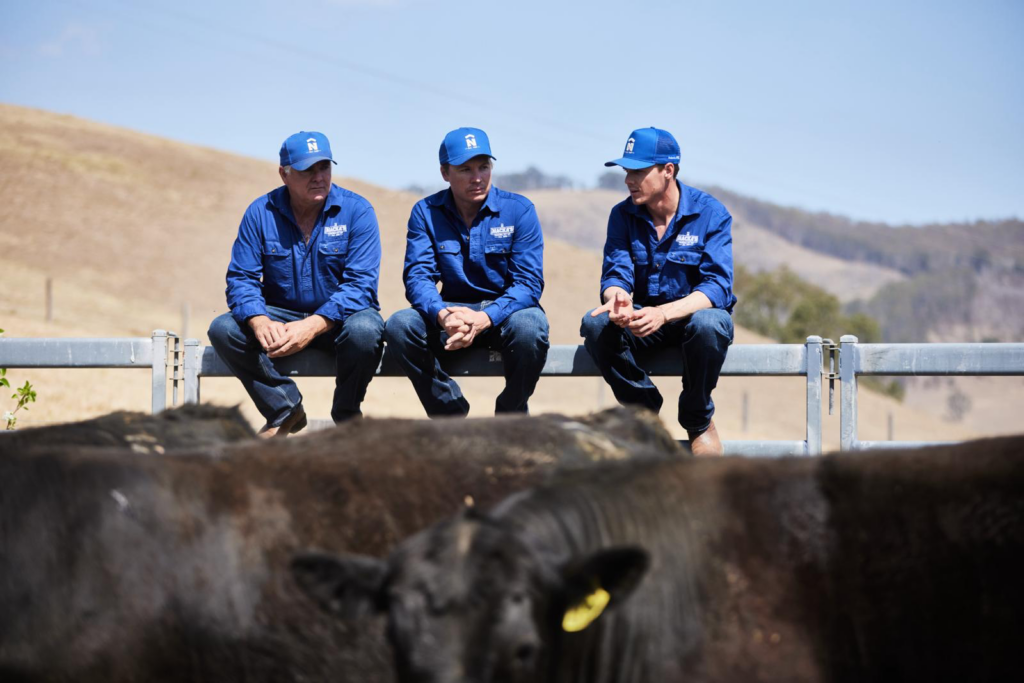
Robert Mackenzie with his two sons James and Jack Mackenzie
Robert will share some of the secrets to their success when he presents `How to set new heights through the adoption of best practices and sustainable farming techniques’ at the GA 2024 Today, Tomorrow and Beyond conference in Geelong on March 18-19.
Macka’s has recently entered an exclusive partnership with Rawburn Aberdeen Angus in Scotland. This builds on continuing to invest heavily in elite genetics, based on their breeding philosophy: pedigree, phenotype and performance. This includes the 2021 purchase of Texas ICEMAN for a record-breaking $225,000 and follows a long-standing commitment to producing sustainable cattle in a sustainable farming system.
In the quest to develop their genetic program, Macka’s identified the Rawburn herd in Scotland as a leader in feed efficiency.
“We are so impressed with the work Rawburn has done in identifying, testing and selecting genetic combinations that are leading the industry in feed efficiency,” Robert said. “This, coupled with generations of maternal genetics and phenotype that suit our environment, made this partnership a must.
Robert said that feed efficiency is important for the bottom line. “If you’re feeding animals in a feedlot situation, or if they are grazing on pasture, you want them to be converting feed into weight gain. Feed efficiency is also important when converting back to how many days the animal is in the supply chain.”
In 2023 Macka’s achieved carbon neutrality naturally, testament to an ongoing commitment to sustainable farming practices as well as its genetic improvement and development.
Macka’s has been working with Genetics Australia to market ICEMAN and Robert said the bull had well and truly exceeded expectations “not only in our herd but in many operations around Australia and overseas, especially in Europe and the UK where some of the leading breeders have been using him for the second breeding season. The orders for him into the EU have doubled again this season. We’re getting great feedback from many people.”
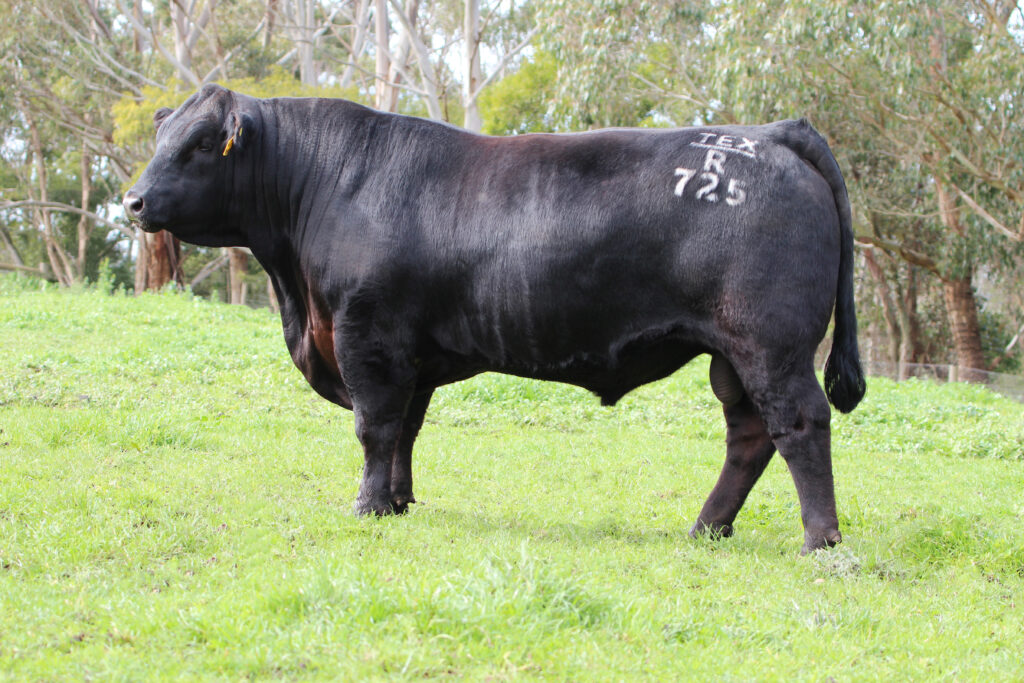
Texas Iceman R725 making having a genetic influence at Macka’a Angus
Phenotypically, ICEMAN ticks all boxes. He is structurally sound with excellent feet and legs which combined with tremendous length of body making him so well balanced. He has a well laid in shoulder with impressive neck extension which gives him real presence and sire appeal, and boasts an outstanding head and jaw, along with a great carcass. He has width across the top which extends right down the hind leg and his skin is as soft as silk which demonstrates his easy doing ability. To top it all off his temperament is second to none which is key in our program.
Jack added that ICEMAN’s success was not just about the semen sold. “It’s what he’s done to our herd. That’s what we brought him for – to make a genetic influence in our herd. We can look at his progeny now and see the impact he has made in such a short amount of time.”
“We’re now using ICEMAN sons over commercial cows and you can see that shape and structure that he is famous for, along with his width, soft skin and easy-doing ability. We’ve been really impressed to see the consistency across his progeny.”
Macka’s runs 3,500 commercial breeders and 200 seed stock breeders and Jack says the move to carbon neutrality is “all about good farming practices”.
“It’s what we’ve been doing for generations and generations; rotational grazing, organic fertiliser, variable rate spreading, mulching, multiple grass species working together in harmony above and below the ground. In that sense we didn’t have to change a lot. We just continued what we were doing well and did it a bit better.”
Robert’s talk at the GA 2024 Today, Tomorrow and Beyond conference will highlight the importance of genetics in their drive for sustainability. “Genetics are a piece of the puzzle for best farming practices and sustainable agriculture. From paddock to plate, genetics play a massive role.
“At the end of the day, if you have the right genetics for your environment, it makes it a lot easier to tick a lot of boxes.”
Jack adds that the focus on quality and sustainability also helps the bottom line. “It costs as much and takes just as much time and effort to raise a substandard animal as it does to raise a good one. We’re putting our focus on raising quality cattle.”
The GA 2024 Today, Tomorrow and Beyond conference in Geelong on March 18-19 will showcase new research and ideas that will shape the future of cattle breeding in Australia.
The conference will feature local and international speakers, farmers and dairy and beef industry leaders.
It will be the first in-person industry-wide conference hosted by Genetics Australia (GA) after an earlier event planned for 2020 was moved online due to the pandemic.
CEO Anthony Shelly said the conference aimed to inspire the current and next generation of farmers to use genetics and other cutting-edge technologies to advance their operations.
It will create a platform to bring together people in the dairy and beef industries to learn how new research and ideas can improve their businesses and help create more sustainable and profitable farming systems.
The program will cover beef industry insights and strategies, the advantages and disadvantages of the MOET and IVP IVF systems, reduced emission feeding strategies, using semen donors and sexed semen to maximise joining outcomes, unlocking international opportunities with the World Angus Evaluation, the return on investment from 40 years of genetic improvement, the next genetic frontiers, the role of genetic improvement in creating greater integration between dairy and beef industries, the importance of estrus intensity and how IVF can be used for herd development.
Findings from Australian research into breeding healthier cows will be presented by project specialist at DataGene and PhD Candidate at LaTrobe University, Michelle Axford.
Agriculture Victoria Breeding for Sustainability and Resilience research director Professor Jennie Pryce will lead a panel discussion on breeding for sustainability and resilience.
There will also be farmer panels on robotic milking, making measurable differences, and sustainable farming practices.
It is intended to hold the conference biennially.
The conference will be at GMHBA Stadium 370 Moorabool Street South Geelong. People can visit https://genaust.com.au/ga2024conference/ for program and ticketing information.
Visitors to the Genetics Australia 2024 Today, Tomorrow and Beyond conference in Geelong on March 18-19 will learn how genetics hold the key to a sustainable farming future.
Agriculture Victoria Research Director of Genomics and Cellular Sciences, Professor Jennie Pryce, will lead a panel discussion on breeding for sustainability and resilience and says genetics are leading the way to a greener future.
The panel will feature an ensemble of researchers from Agriculture Victoria to present a diverse range of topics relating to sustainability and resilience.
Professor Pryce leads a team responsible for delivering genetic improvement tools to the dairy industry and she says there is a fantastic story from the major investment by the dairy industry to help farmers and there are more achievements on the horizon.
“Everything we do culminates in a breeding value that DataGene releases for dairy farmers to use,” Jennie said.
DataGene is responsible for driving genetic gain and herd improvement in the Australian dairy industry, via research, development and extension.
“Agriculture Victoria developed the Heat Tolerance breeding value in 2017 and is working on an update to that which, all going well, will become available for farmers this year.”
“Agriculture Victoria are also using more data and robust information to identify cows that are tolerant to hot and humid conditions and evaluating the reduction in yield as temperatures and humidity increase.”
The team also did the research behind the Sustainability Index which includes extra weighting on green traits; such as feed efficiency, milk production and longevity.
“What Agriculture Victoria is trying to do here is identify the cows that are better converters of feed into milk, which reduces methane emissions because they’re using the feed more efficiently. Also, if they have a more productive life, you need fewer non-producing animals and that means your overall farm footprint is lower. That’s the first step in breeding for sustainability directly by trying to reduce methane emissions.”
Jennie says Australia’s dairy industry is already well placed and its farmers are keen adopters of progressive traits.
“Farmers selecting for efficient and productive cows, which has been going on for many decades now, has actually meant lower emission per litre produced. This will give us more of an edge to drive down emissions faster.”
She says the push is even stronger now, and farmers are embracing the challenge. “We’re developing traits that farmers like anyway. Farmers are using the Sustainability Index because they want cows that are better converters of feed into milk and also live longer. It’s a win-win situation.”
The team’s next priority is to measure methane emissions directly from individual cows.
“The Sustainability Index will get us part-way to the zero emissions goal by 2050 and genetics are obviously the long-term sustainable option for farmers and for the environment,” Jennie said.
“It’s going to take a lot of investment to get individual cow methane measures but we are living in a time where we’ve got genomic selection which will enable us to achieve that.
“Agriculture Victoria want to measure methane emissions on individual cows and marry that to genomic data. As long as you’ve got enough individuals with genetic markers and methane measurements, you could develop a breeding value for methane emissions.
Jennie said that Australia has a well-established team to tackle the issues as part of a huge collaborative global movement. “We’re not working in isolation, which is really positive, globally we’re trying to solve this together.”
Jennie added that farmers and the dairy industry needed to remain proactive. “The sticks aren’t there yet but this is an opportunity for farmers to get on the front foot and prepare the herd for the future.
The panel also includes:
- Christy van der Jagt, Senior research scientist and leader of Green Cow project, “Green Cow” overview
- Fazel Almasi, Research Scientist of Green Cow project: Using sensors to combat climate change – improving feed efficiency and reducing emissions
- Laura Jensen, PhD student at DairyBio: Using sensors to combat climate change – resilience to heat
- Boris Sepulveda, PhD student at DairyBio: Reducing methane emissions using the microbiome.
Semen and Heifers arrive in Pakistan
Another semen shipment landed in Pakistan in late 2023, closely followed by the second shipment of dairy heifers from Australia. HRM Dairies, Genetics Australia’s exclusive semen distributor, arranged a second shipment as demand for well-bred Australian heifers continues to grow in Pakistan. The live heifer shipments were predominately selected on Australian genomics and most were pregnant to sexed semen from bulls such as VARLEY, PILBARA and EASTERN. The shipment arrived in early February and 100% of the heifers are now settled into their new homes.
Included in the shipment were Australia Red heifers as well as Jerseys. Interest is growing for breeds other than Holstein as farmers are seeing the advantages offered by these breeds.
HRM is genomic testing all heifers, the only herd outside of Australia that is genetic testing on Australian genomics. A heifer HRM Pilbara August 1304 ranked 21st nationally on BPIg in the December 2023 ABV release. Her $BPI is $528 and will be flushed and used to continue to develop the HRM dairy herd in Pakistan.
Included in the semen shipment was a mix of conventional and sexed semen. Semen from more than 40 bulls was included in the shipment with larger quantities of Holstein bulls PILBARA, VARLEY, MAEBULL, GILES, VITTORIA and EASTERN while in the Jerseys PICKLE and STARK PP were popular as was ARBSKEETA in the Reds.

The Friesian Express docks in the early hours in Karachi with 1200 pregnant heifers on board from Australia

Heifers have adapted well in Pakistan
German shipment to be used in cross breeding
A semen shipment including all three major dairy breeds was shipped to Hamburg in Germany. Going to Hybrid Genetics, the shipment included leading bulls such as ARBSKEETA, and homozygous bulls, Jersey STARKPP and Red Holstein VITTORIA. Semen will be used in three-way crossbreeding programs promoted by Hybrid Genetics.

Udo Carstensen, owner of Hybrid Genetics in Germany, in Australia inspecting daughters and bull mothers he is importing into Germany for his three-way cross breeding programs.
Indian Delegation impressed with Australian Research
Genetics Australia participated in a recent delegation from India. Delegates from the Indian National Dairy Development Board [NDDB] and the Department of Animal Husbandry and Dairy [DAHD] visited Australia to build and strengthen relationships between key Indian dairy stakeholders and the Australian dairy industry.
The delegation was supported by the Australian Government [DFAT and DAFF], the Australia High Commission in New Delhi and Dairy Australia. The delegation visited milk processors, dairy farmers, DataGene and DairyBio.
India has a large dairy industry and currently no health certificate has been negotiated between the two countries. There is real interest to cooperate on areas of research and the group was most impressed with the emissions work being undertaken at Ellinbank Research Centre and the presentations from researchers and staff from DataGene.

Professor Joe Jacobs explains the work Ellinbank is conducting on capturing and monitoring methane emissions.
The delegation also visited Wallacedale Jerseys at Poowong North. The Wallacedale herd is one of Australia’s leading suppliers of elite Jersey genetics and a number of bulls such as STARK PP and PICKLE, and GOLDBANDP rank high from the herd. Owner Luke Wallace outlined his breeding program and robotic milking system and the group walked through part of the herd. India has imported Jersey genetics and live bulls from Denmark and based on the quality of cows seen at Wallacedale Jerseys, the group is very keen to commence importing semen, embryos and cattle from Australia
Intrest in Australia Jerseys on the rise in the USA
Genetics Australia joined Jersey Australia along with several Australian breeders to hold a display at the World Dairy Expo [WDE] in Madison USA. Interest in Australia Jerseys continues to grow and more semen is being exported year-on-year.
Following WDE, the group visited Golden Dreams Jerseys owned by the Cline family in Decorah Iowa where they inspected an Excellent 94 AUSSIEGIOLD daughter who has subsequently been classified EX95.

Jersey Australia President Lisa Broad, Broadlin Jerseys Wonthaggi and Kerrie and Holly Anderson from Kingsville Jerseys in Drouin South attracted a number of visitors to the Jersey display.

Lynton and Lisa Broad from Broadlin Jerseys were pleased to see a EX95 daughter of their bull AUSSIEGOLD milking at Golden Dreams Jerseys in Iowa.