



Genetics Australia Theme
Former National Herd Development (NHD) marketing manager and industry stalwart, Christian Hickey, is the inaugural recipient of a new NHIA award for outstanding contribution to industry.
The award recognises demonstrated excellence and a significant contribution in advancing the herd improvement industry.
Christian, who has now retired from National Herd Development Co-op, was recognised by the National Herd Improvement Association of Australia (NHIA) at the Association’s annual industry dinner in Shepparton, Victoria last month.
NHD Chair Paul Weller noted Christian’s contribution in increasing farmers’ understanding of genetics and his role in implementing the NHIA accredited AI Technician Program in the early 2000s as career highlights that significantly improved Australia’s herd improvement industry.
“Christian’s knowledge of genetics and breeding has few peers in Australia,” Paul said. “Over more than 25 years with NHD, Christian has always embraced change – for the betterment of the industry – be it within genetics or business. Among many things, he witnessed and played a major role in developments that give us today’s rapid rate of genetic gain obtainable with the use of sexed semen and genetic testing. He has always met challenges head-on and has done so with a smile on his face; and he likes nothing more than putting a smile on someone else’s.”
NHIA CEO Sara Merckel said Christian had spent his career increasing farmers’ knowledge of how genetics can help them improve their businesses. Christian leaves the industry in a much better place than it was at the beginning of his career.
“Christian’s dedication to advancing genetics knowledge has significantly impacted Australia’s agricultural landscape.
International Dairy Week
Genetics Australia had a good number of visitors to the display at IDW in January. This was the first where Genetics Australia and Total Genetics had a joint display and the first IDW since the passing of Greg Tiller, GAs long term Northern Victoria Territory Manager.
While Greg’s absence left a sad note, the joint display attracted a lot of attention and mild weather during the week made IDW enjoyable for visitors, exhibitors and the show cattle.
Create the Future sale
The Create the Future sale held on Wednesday evening during IDW created a lot of spirited bidding. Lot 13 Jelbart Diamond Barbe 16916 was the highest ever BPIg heifer offered for sale, being the Number 1 BPIg heifer after the December 2023 ABV release at $583BPIg. Ranking in the Top 1% for BPI, HWI, SI ASI, Mastitis Resistance, and a Fertility ABV of 121 made her an outstanding heifer. She was put up for sale by Jelbart Dairies from Leongatha South.
The heifer was sired by GA Holstein KARAT, a bull on the rise and adding milking daughters with a December 2023 ABV release of $540 BPIg. Her Dam is a Jeronimo, the next Dam back is a high production MEDALLION daughter. The MEDALLION had a five-lactation average of 11,849 litres 411kgs of Protein and 388kgs Fat.
Former GA Progeny Test Coordinator and now Cihuna dairy farmer Heather Campbell was the astute final bidder. The heifer will be flushed and contribute to the herd breeding program with a possible view for her to contribute to future bull teams. A young bull, POLLGARTH [$473BPIg] entered the GA lineup in late 2023, was also bred by Heather.

Heather Campbell was pleased with her purchase of the Number 1 genomic heifer Jelbart Diamond Barbe 16916 at the 2024 IDW sale.

Tim Jelbart from Jelbart Dairies and Jelbart Dairies Farm Manager Mike Killkenny with purchaser Heather Campbell.
ADC Conference well attended
Genetics Australia attended the Australian Dairy Conference , the largest conference in its 20 year history. We were please to catch up with a number of farmers to discuss the performance of past bulls and a look to what is new for 2024.

Genetics Australia (GA) has solidified the future of a local Australian Red breeding program by taking over the marketing and distribution of the Auzred XB genetics portfolio. Starting from January 1, 2024, GA will be responsible for the ownership and management of the Auzred XB Semen portfolio, consisting of six primary active sires.
Auzred XB stands as the largest Australian Red breeding program in the country, outside of GA’s existing program. The portfolio will be seamlessly integrated into GA’s Australian Red genetics program.
GA CEO Anthony Shelly stated that this strategic acquisition aims to bolster the Australian Red breed, ensuring a sustainable scale for the breeding program, fortifying GA’s market position, and exploring export opportunities.
“This move also positions Genetics Australia as the premier and most comprehensive supplier of Australian Reds to farmers,” Mr. Shelly emphasized.
Co-owners of Auzred XB, Karen Moroney and Steve Snowdon, expressed their enthusiasm for the transaction. Mr. Snowdon mentioned their desire to slow down and their eagerness for the portfolio to be entrusted to Australia’s leading genetics company.
“We’ve built a strong team of Australian Red bulls, and Genetics Australia’s market presence will do justice to them beyond our capacity,” Mr. Snowdon explained.
Both co-owners thanked their loyal clients and anticipated continued access to high-quality Australian Red products. Mr. Snowdon emphasized the promising future of the Australian Red dairy breed, citing its increasing popularity, especially in cross-breeding.
The merger of the two portfolios, according to Mr. Snowdon, strengthens the Australian Red breed offering. Notably, active sires such as REDROLLO and GEORGE2 are beginning to have their first milking daughters, and promising young bulls like ARRAGNA are expected to thrive under Genetics Australia’s market influence.
Ms. Moroney, whose father, Bill Thompson, introduced Red genetics in Australia, expressed excitement about GA’s resources propelling the breed’s growth. She highlighted the significance of this move, emphasizing that GA’s acquisition of Wacol AB in 1994 marked the recognition of the new breed’s potential in the Australian dairy landscape.
Mr. Shelly affirmed GA’s long-term commitment to developing the Australian Red breed. Acquiring the Auzred team, he said, would further fortify GA’s position, enabling continued investment in the breed for local growth and international expansion. He noted the recent introduction of publishable genomic breeding values for Australian Reds, enhancing the breed’s capacity to improve its base genetics.
Additionally, GA will also take over the distribution of Montbeliarde semen sourced from Coopex, previously handled by Auzred XB.
In a testament to the increasing demand for Australian genetics in Pakistan’s agricultural landscape, a fresh shipment embarked on its journey this week. Boasting an extensive dossier of health testing and documentation spanning nearly 900 A4 pages, the consignment is set to make a significant impact.
The shipment includes both conventional and sexed Holstein and Jersey semen sourced from top-rated bulls. This strategic selection aims to cater to the diverse preferences and breeding objectives of Pakistani farmers, reflecting the commitment to enhancing livestock quality in the region.
Prepared well in advance of the approaching Pakistani winter, the timing aligns with the peak mating season from December through to February. This foresight ensures that farmers in Pakistan have access to premium genetic resources precisely when needed, optimizing the breeding process for optimal results.
Australian genetics have gained prominence globally for their proven track record in improving livestock quality and enhancing overall herd performance. The decision by Pakistani farmers to invest in these genetics underscores the recognition of the value they bring to the local agricultural sector.
As the agricultural landscape continues to evolve in Pakistan, partnerships and collaborations with global leaders in genetics, such as Australia, play a pivotal role in ensuring sustainable and productive farming practices. The arrival of this latest shipment marks another milestone in the flourishing relationship between Australian genetics and the agricultural community in Pakistan.
Genetics Australia is proud to partner with our Pakistani distributor HRM Dairies to deliver elite Australian bovine genetics to Pakistan
Genetics Australia is thrilled to be sponsoring the 2024 Angus Youth National Roundup. We share Angus Australia’s passion and enthusiasm for supporting the next generation and recognise the valuable opportunity that the roundup offers these young people.
Our beef product manager Damien has been involved in the Angus youth program himself. He knows firsthand the amazing learning and networking that these events facilitate. “Getting involved in the Angus youth program is what really lit the fire for me, there’s something about being amongst this community that gives you so much energy and enthusiasm for the future of the beef industry.”
Genetics Australia is proud to be leading the way in genetic products and services, partnering with Australian cattle producers to breed better beef herds. With a longstanding reputation as a trusted genetics provider, our unwavering commitment to supplying genetics tailored for every market and environment is a cornerstone of our business.
Genetics Australia is proud to maintain a ‘whole of supply chain’ perspective. This means that we target genetics that offer value at every stage of production, from conception to consumption.
Recently partnering with URUS, Genetics Australia has access to international distribution networks and the ability to collect CSS and EU qualified semen at our collection facility at Total Livestock Genetics (TLG) in Camperdown. Enabling us to bring the world’s best Angus genetics to Australia and take Australia’s best Angus genetics to the world.
We are looking forward to seeing the roundup go bigger and better in January 2024 and can’t wait to catch up with everyone in Tamworth!
The Genetics Australia 2023 Annual General Meeting will be held at The Ballantyne Centre, 9 Hastie Street, Tatura, Victoria, 3616 at 7pm on Monday 20th November, followed by canapes and drinks for members and guests. Light refreshments will be available from 6.30pm prior to the meeting.
At the end of what has been an exciting year for GAC members and industry guests are being encouraged to attend in person. For those unable to make it to Tatura on 20th November there is an option to attend the AGM online.
Attending the AGM
To attend the AGM in person at the Ballantyne Centre please RSVP to Tyler Shelly at [email protected] by Tuesday 14th November with the number of people attending and any dietary requirements.
To attend the AGM online please complete the Online Registration form. Once registered you will receive a confirmation email with information on how you can participate in the meeting
Annual General Meeting Documents
The following documents relating to the Annual General Meeting are available to download by clicking on the highlighted text:
If you intend to participate and vote but cannot attend on the day please complete and sign the Proxy Form and return it to [email protected] at least 24 hours before the scheduled start time of the AGM.
Damien Thomson admits he’s a bit obsessed when it comes to beef cattle genetics, so his new job as Genetics Australia’s beef manager is like a dream come true. Damien grew up around beef with his family cattle operation Shacorrahdalu Angus at Yass, NSW (the title created from abbreviations of the names of the family’s five children). A career combining agriculture, economics and business was always on the cards and Damien’s love of genetics makes this job a perfect choice.
“It goes beyond a passion for me; I’d call it an obsession,” Damien said. “I’d describe myself as obsessed with genetic improvement. Being able to find and source top bulls and market them to clients to enhance their genetic improvement is very much a dream job.”
This isn’t a new obsession, although Damien admits his fiancé Caitlin says he currently spends far too much time looking at bulls.
“From an early age, I remember being introduced to the idea of EBVs and how you could take a cow with a high birth weight and cross it with a bull with a low birth weight and get the average of the two,” he said. “I’m not sure what it was, but I latched on to it from a young age.”
Damien’s appointment is part of Genetics Australia’s push to grow its beef operation. His role will involve developing and expanding the beef genetics business, marketing the current bull catalogue, developing relationships with clients, sales, and procuring new sires and working with the team in determining the direction for beef genetics. “We’re looking at how the business wants to be positioned in the beef genetics space,” he said.
Damien’s parents Peter and Liz bought their first farm in 1998 running commercial Angus. They purchased their first seven stud cows in 2009, building up the herd to calve about 200 stud cows this year. Much of that growth was achieved through embryo transfer. “We also run a 350-head commercial herd and put a lot of embryos from the stud herd into them to increase numbers and promote genetic gain.”
Damien, 26, grew up in Canberra but went to the farm on weekends since he was one-year-old.
“I love working on the land and with cattle, and making consistent progress in something you own and build up. Industry wide, the people are the main thing for me. The networks and relationships you build up are wonderful. It’s a really enjoyable industry to be part of.”
Damien has been heavily involved in the breeding program at Shacorrahdalu. “We have a breeding program focused on objective genetic improvement for commercial beef production while also balancing genotype and visual assessment of the cattle,” he said. “We use the tools of genomics and EBVs to make the best possible selection decisions.” They are rightly proud of their progress. The stud has been recognised in Bush Agribusiness’s Top Studs publication for its genetic progress.
“Angus Australia produces quarterly reports for genetic benchmarking and we’re constantly keeping track of our genetic progress and also comprehensively recording the performance of our own herd and tracking the actual performance of the animals,” Damien said. “Genomics is a very powerful tool for using the animal’s DNA to predict its performance and the performance of its progeny, but it doesn’t work if it doesn’t have the raw data behind it. We’re very committed to collecting that data in our herd and have been involved in the Angus Sire Benchmarking Program, entering bulls in recent years.”
Damien’s love of the industry and its people led to his involvement in the Angus youth program. He won the Stud Master title at his first Round Up in 2019, an award that focuses on young, promising breeders.
In January this year he travelled to New Zealand after winning a Trans-Tasman travel bursary.
“That was awesome,” Damien said. “I spent four weeks meeting and staying with breeders and getting to understand their programs and different environments and markets. What they target in their genetics was a real eye-opener. It was a pivotal point in my career in understanding the requirements and power of genetic improvement” “In Australia we are very feedlot and grain-fed focused, in New Zealand they only have one feedlot so they are very much a grass-fed production system which is their main selling point. They have very steep hills but very good pasture growing conditions so they like good structure, low mature weight and high fat for grass finishing.”
Damien says one of the best things about breeding Angus cattle is its diversity. “The tour gave me a better understanding of that and the different perspectives and why they need to target different traits,” he said. “I’m looking forward to doing something similar in Australia – getting around the country and understanding people’s programs.”
Prior to joining Genetics Australia, Damien worked for AuctionsPlus as a senior market analyst and before that was with ABARES as an industry economist, his first job after graduating from University of New England with a Bachelor of Agricultural and Resource Economics and Sciences. “I knew from a young age I was going to work in a mixture of agriculture, economics and business and I feel like I’m part of something bigger.”
Despite the challenges of tough seasons and current low prices, Damien sees a positive future for the beef industry. “It’s incredibly patchy seasonally and it looks like we’re in for a tough and long summer. Prices are quite low, adding to that tough situation, but I think the long-term trajectory of the beef industry is incredibly positive.
“We produce a world-class product that is in demand in international markets. We have a very sustainable and green image which gives us huge opportunities for the future.”
Damien and Shacorrahdalu Angus have had a long connection with GA, using a number of AI sires, including the current Tehama Testament.
A new genetic disorder was recently identified within the Holstein breed. Formerly called calf recumbency – has now been named Early Onset Muscle Weakness Syndrome (MW). Below, you will find questions and answers explaining MW and our approach to mitigating its impact.
Please note, this genetic disorder has proven more complex than other recent genetic defects and additional research and testing is being conducted. For further details, read this industry statement on recumbency in Holstein calves available on the Council on Dairy Cattle Breeding (CDCB) website. Also review this May 2023 statement from Holstein Association USA.
What is Early Onset Muscle Weakness Syndrome (MW) in Holstein calves?
MW is a genetic disorder that affects Holstein calves’ ability to stand. Calves affected by MW are unable to stand at birth or lose the ability to stand shortly after birth.
What is the frequency of MW in the Holstein population?
Currently, the population frequency is unclear; however, MW has been traced back to some influential Holstein bloodlines and is likely to be present in all A.I. breeding programs to some degree. In particular, influential bloodlines that are known to carry this genetic defect trace back to Roylane Socra Robust and his son Seagull-Bay Supersire (both are MW carriers). We can assume there will be more as further testing is conducted.
A gene test has been developed using research by scientists at Penn State University that can identify carrier animals, but a haplotype test is not yet available from CDCB.
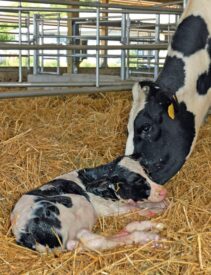
The newly identified genetic defect, originally called recumbency in Holstein calves, is characterized by the calf’s inability to stand at birth or the loss of the ability to stand shortly after birth.
How can I mitigate the impact of MW on my herd?
Where animals are ready to be joined that are sired by known carrier bulls, simply select a bull from the active list that are tested non carriers. If the heifers to be joined are not sired by carrier bulls or are sired by bulls of unknown status we suggest the genetic merit of the intended sire is considered and the bull used given the low percentage of bulls identified as carriers.
Our GENESCREEN™ mating program will be updated to prevent matings between known MW carriers. It is important to note, that there is currently no industry source file for MW status. As a result, we are unable provide certainty of when this tool will be available.
Where can I access MW test results on GENETICS AUSTRALIA bulls?
Below are the most recent test results on GA sires, as of September 2023. Use the link below to download a PDF file of active GA sires.
MW Test Results on Active Sires
How are the test results labeled?
The tested bulls have been grouped into three categories: Free, Carrier or Affected. The bulls listed as “N” are tested free of MW. Those labeled “Carrier” have tested heterozygous for MW, and those labeled “Affected” are considered homozygous for MW.
Note that this deviates from the historic understanding of genetics where a homozygous designation (Affected) is traditionally lethal. At this point, it is believed the affected individuals may have recovered from the genetic defect, but the reason is not yet fully understood.
Also note that consistent and concise labeling is being established across the industry to ensure MW is universally recognized. Once decided and available, we will add and update labeling across our Genetics Australia platforms.
What percentage of animals would result in a lethal outcome if random mating took place?
While we do not know exact details or prevalence in the population, we can provide an example based on a reasonable prevalence rate. If the prevalence rate is 10%, then the risk of a lethal outcome is 0.25% of randomly mated animals (see below).
- .10 x .10 = 0.01 (assuming a 10% prevalence chance for both dam and sire)
- 0.01 (above) x .25 (chance of a lethal if both carriers) = 0.0025
- 0.25% of randomly mated animals will result in a lethal outcome
If you have further questions, regarding the MW (or recumbency) genetic defect impacting Holstein calves, please reach out to your local Genetics Australia representative.
Ashlea Cross grew up in suburban Warrandyte and went to school in suburban Ringwood but still found a way into agriculture.
It was Ashlea’s school that inspired her interest in agriculture and particularly breeding, which continues to grow as she takes on a new role as Genetics Australia’s southern beef representative. “If I didn’t go to the school I went to, I wouldn’t be working in agriculture,” she says. Ashlea attended Tintern Grammar and got involved with its agriculture and sheep breeding program from year 7, and by year 11 and 12 she was leading the program.
Ashlea’s immediate family has no connections to agriculture although she has family members who own cropping farms in the Riverina, but that and her city base were no limitation.“I often think about what got me interested and it was definitely from school,” she said. “I was only exposed to the agriculture field from when I was a teenager.”The genetics and breeding part of the course struck a particularly strong chord, giving Ashlea, 21, a good grounding for her new job with Genetics Australia.
“I’ve always loved animals and also enjoy biology and the genetics side of things. Animal breeding really appealed to me when I was at school and in the work I’ve done since, I love the stud breeding and genetics side it.” Ashlea is approaching the final trimester of her Bachelor of Agribusiness majoring in rural science at the University of New England and has had on-farm experience with Paraway Pastoral Company near Ballarat, and worked in the grain industry and with Nutrien Ag Solutions.
She is now looking forward to learning more about the beef industry and its farmers. “This job appealed to me for the opportunity to get out and meet producers and get to see the product of their breeding and to help them to advance their breeding.”
Along with her twin sister Olivia, Ashlea will also continue to develop her own sheep stud based in the Yarra Ranges.
“We enjoyed it so much that we decided to breed the same breed as the school and develop our own Romney stud,” she said. Ashlea has also judged numerous sheep and fleece competitions.
Ashlea will be based near Lake Bolac and servicing producers in Victoria, Tasmania and Western Australia under the mentorship of John Gommers.
Australian genetics are set to conquer new worldwide markets following the launch of a major international joint venture.
The joint venture between Genetics Australia Cooperative (GAC) and global herd improvement leader URUS Group LP (URUS) is expected to take existing Australian products into many new international markets.The new entity will be formally known as Genetics Australia Holdings Pty Ltd and will continue to trade as Genetics Australia. It officially launched on July 1. CEO Anthony Shelly says the joint venture will have huge benefits for Australian farmers, not only offering them an expanded product portfolio but in helping their genetics to reach new markets. “We’ve had planning sessions with the global sales teams and it is clear there is a lot of interest in Australian genetics,” Mr Shelly said.“The exposure Australian semen is receiving even before the joint venture starts is quite overwhelming. We are very excited and confident that new orders will come.”
Mr Shelly said the interest was based on the excellent reputation enjoyed by Australia’s grazing genetics. “People see what is happening in Australia and want to be part of it. This new joint venture will open many new markets for us.” Mr Shelly added that interest was particularly strong in South America. “We will be following up opportunities in the near future and this promises to be an exciting time for Australian farmers.”
The joint venture received overwhelming support from Genetics Australia Cooperative members and formal approval from the Registrar of Co-operatives. URUS is a global leader in products and services for dairy and beef producers for artificial insemination, genetics, reproduction, and farm management systems, servicing more than 80 countries with brands such as GENEX, PEAK, VAS and Trans Ova amongst many others. GAC is the leading Australian owned artificial breeding supplier, supplying genetics and herd improvement merchandise products used by Australian dairy farmers and to several international markets to improve their herds.
The JV will be 60 per cent owned by URUS and 40 per cent owned by GAC. It will have access to the full suite of GENEX products and access to the PEAK breeding program. Mr Shelly said the partnership with the GENEX co-operative was particularly helpful and sat well with GAC’s history as a co-operative.
GENEX CEO Huub te Plate described the joint venture as a testament to the co-operatives’ commitment to drive innovation and deliver top-notch genetic solutions to members and customers. “Genetics Australia Cooperative shares our passion for excellence, and we are excited to combine our expertise and resources to shape the future of the cattle genetics and reproductive services industry. GENEX and Genetics Australia Cooperative have a deep history and passion for our members and customers, this joint venture makes perfect sense, he said.