




Genetics Australia Theme
Elections are to be held for two (2) positions on the Board of Directors of Genetics Australia Co-operative Limited.
The term of two Directors is expiring – Mr. John Pekin and Ms. Lucinda Corrigan have offered themselves for, and are eligible for re-election. Ms Lucinda Corrigan was appointed by the Board during the year to cover a casual vacancy arising from the resignation of Mr. Rohan Sprunt. Lucinda and her family run a large-scale Angus genetics business in Southern NSW (1900 cows) and she is a non-executive director of DataGene and Chairs the Animal Genetics and Breeding Unit at the University of New England. She is considered to have the skills, knowledge and diversity to add value to the Genetics Australia Board.
Nominations are invited for any active members of Genetics Australia Co-operative who may wish to nominate and stand for the position of Director.
Active members of Genetics Australia wishing to nominate for election must do so by lodging their nomination at the Registered Office on or before 4:00pm on Friday 21st October, 2022. A nomination must be signed by five or more members, must provide details of the qualifications and experience of the person being nominated and be accompanied by a notice in writing signed by the nominee consenting to their nomination.
A Director has a duty to act with due care and diligence, to act in good faith, to not gain an advantage by improper use of their position, to not misuse information and to prevent insolvent trading. A Director also has the responsibility of keeping confidential information confidential, to not disclose non-public information unless authorised by the Board or legally mandated and to not use information for an improper purpose.
The current base remuneration of a Director is $16,363.20 per annum plus superannuation. A Director is also entitled to receive $500 per day or $250 per half day for attendance to the business of the Co-operative that is additional to normal Board activities.
If the number of nominees exceeds the number of vacancies, the election of directors must be conducted either by ballot or at the annual general meeting in the manner the Board directs.
Contact the Company Secretary, Tony Phillips, on 0417 927 539 or [email protected] or Head Office on 03 5367 3888 for further details on nomination and election procedures and consult the GAC website www.genaust.com.au.
Download electionnotice:click here
Download 2022 Annual Report: click here
Advance notification of AGM
This is to confirm that the 2022 Annual General Meeting will be held at 11:00am on Tuesday 22nd November 2022 at the Grand Ridge Brewery, 1 Baromi Road, Mirboo North, Vic 3871. The directors have resolved to allow attendance at the meeting in person and the meeting will also be a virtual AGM, livestreamed to allow attendance via Zoom or Teams.
Forgetcrime or romance novels, Heywood farmer Katrina McRae likes to read the latest data on her cows when she goes to bed at night.
As one of the first farmers in Australia to use Tru-Test Automated Heat & Health Monitoring system, Katrina is impressed with the information she”s getting.
‘I like to lay in bed at night and go over the data and check up on what”s been going on and make sure everything is good and all the girls are happy,’ she says.
‘I”ll also sit up early in the morning on the laptop before milking, to get a better idea of what”s going on, and to add my notes and update any info. I like to do that each day so we can stay on top of cow health; it”s pretty important this time of year when we are AI”ing.
‘So far, we are really happy with how the collars are performing and also the data available and just how easy it all is to use.’
The 227 Holstein cows on the farm are like family to Katrina and her partner Kerry Cowland, so much so that she regularly refers to them as ‘the girls’.
The Tru-Test Automated Heat & Health Monitoring with Active Ear Tags and Active Collars are marketed in Australia by Genetics Australia. They were added to Katrina”s cows around the start of April.
With two-year-old son William and daughter Sophie just entering high school, Katrina wanted to improve time management while also getting a higher in-calf rate.
‘One of the most important things to do is watch your cows, but we felt there had to be a better way of doing it and we wanted to cut down on the time we spend sitting in the paddock watching cows,’ she said.
‘Putting collars on just made sense. It gave us more time to do other jobs around the farm because the system is taking care of what we used to spend hours and hours doing every day.’
She”s already seeing the returns on her investment.
‘They are picking up heat that we probably wouldn”t see and they”re also picking up cows that aren”t cycling, which is something we might not pick up till later and it could be too late.’
Katrina wants to eliminate drug use and go with a natural cycling system. She has used Cue-Mate to bring them on and in a group of 17, there were 15 that cycled on their own. Other cows that don”t cycle go into fixed-time AI.
‘We want as many cows as possible cycling in the first few weeks and to get them in calf as early as possible on their natural heat,’ she said. ‘We”re not inducing heat or pumping them full of drugs to get them all coming on at the same time. We”re doing it when they”re ready, and we hope that will give us a higher in-calf rate.’
Tru-Test Automated Heat & Health Monitoring with Active Ear Tags and Active Collars was selected because it could be integrated with the farm”s Easy Dairy data system. Katrina is also upgrading the draft gate to an Easy Dairy system so it can connect with the collars.
The addition of collars was a smooth process. ‘They walk out of the crush with the collar on, swing their head a bit and then they didn”t even worry about it,’ Katrina said. ‘We have a few cows that tend to be naughty and have lost collars but we pick that up and drive to the paddock and find it.’
Katrina praised the Genetics Australia team for assisting with the introduction and teaching her how to make the system work.
She is looking to long-term benefits for herself and the ‘girls’.
‘Everyone is looking for different things but in-the-end, we all want to get our cows in-calf and for our cows to be happy.
‘We”re investing in something that”s going to make our job easier. Every day we”re looking for a way to work smarter and hopefully it will make the girls happier.
‘You”ve got have happy cows to run a dairy farm. If we look after the girls, they will look after us ten-fold.’
Katrina and Kerry took over the farm from her father Andrew three years ago, with Kerry focusing on pasture improvement and Katrina on the herd.
‘The grass is growing and the cows are happy and we”re seeing the results of that in the vat,’ she said. ‘I”m proud of how far we”ve come.’
https://genaust.com.au/tru-test-datamars
The Indonesian outbreak of foot and mouth disease has been a topic of concern in the Australian livestock industry. Given the popularity of Bali as a holiday destination, it has also been an issue attracting headlines in mainstream media. Talk of a potential cost to the Australian industry of $50 billion is alarming. The most recent experience in the UK where over 6 million animals were euthanized in 2001 and brought the UK livestock industry to almost a standstill highlights how devastating it could be if it found its way to Australia.
Dairy Australia has been at the forefront of creating awareness abound dairy producers with a recent webinar sharing the Australian Government response and industry preparedness. It was viewed by a large number of industries including farmers and service providers.
At GA health and quarantine controls and always been at the front of mind as all bulls undergo an intensive series of health testing and checks before they enter the pre-quarantine property and additional testing before they can enter the collection facilities. Now all bulls are at TLG the process is no different where GA or TLG-owned bulls or third-party bulls need to not only undergo this initial testing but also in some cases undergo 6 monthly testing or a minimum of 12 monthly testingwhile a resident of the quarantine facility.
The recent Indonesian outbreak has prompted us to review all quarantine measures and implemented a series of important biosecurity measures.
Visitor access to TLG is restricted with all visitors, contractors and non-staff members will need to complete a Quarantine Declaration Form and overseas travel will need to be declared before access is allowed to any building on the Camperdown property. Protective clothing and foot ware will need to be worn. Bull inspections will not be allowed for the foreseeable future.
Staff visiting farms can only do so with the prior permission of the owner or farm manager and vehicles are to be cleaned and maintained free of mud or manure where possible. Vehicles can only be parked in general parking areas or tanker access areas and no staff vehicles can be used to drive on farms to view cows or on laneways. All GA representatives have been supplied with protective footwear, disinfectant, and a brush to clean footwear.
With the international growing interest in Australian genetics, more overseas visitors are visiting farms in Australia to view progeny, some from countries without FMD freedom. Overseas visitors will be screened prior to any farm visits and supplied with protective footwear and all clothing will be cleaned and not worn on farms in their country of origin.
More information on FMD can be found at www.dairyaustralia.com.au/eadpreparedness. We also encourage all farmers complete a farm Biosecurity Plan, the template can be found on the Dairy Australia website.
The August ABV release has highlighted the strength of Australian bulls with a new focus on sustainability.
With the 40th year of ABV release in Australia to be celebrated in 2023, Genetics Australia CEO Anthony Shelly says the quality of the bulls standing in Australia has never been stronger.
‘It augers well for farmers in Australia to have ongoing access to world-class bulls suited for the unique Australian farming systems,’ Mr. Shelly said.
Genetics Australia has welcomed the introduction of a new Sustainability Index which supports GA”s focus on developing a ‘greener cow’.
‘We continue to identify pedigree diversity combining traits of increased importance such as longevity, health and fitness, feed efficiency, heat tolerance, and polled genetics,’ Mr. Shelly said. ‘Greater emphasis will also be placed on the new Sustainability Index contributing to breeding a ‘greener cow’.
Improvements since the introduction of genomics and access to sexed semen have accelerated the genetic progress in Australia. ‘Traits such as mastitis resistance, and fertility have made significant improvements and access to A22 bulls and more polled options are now available,’ Mr. Shelly said. ‘More farmers are selecting bulls solely based on their ABVs and through world-class research and focus on traits of significance, Australian farmers can be confident when they are selecting Australian genomic or daughter-proven bulls that they will continue to see progress in their dairy herds.’
The 2022 August ABVs have delivered great results for Genetics Australia with a combination of leading genomic and daughter-proven sires.
SUPERPOWER, now one of the best daughter-proven Holstein bulls available, is the highest BPI daughter-proven bull standing in Australia and has a well-balanced overall ABV for production, health, and type. SUPERPOWER was bred by Emu Banks Holsteins, the number 1 BPI herd following the August 2022 ABV release.
SUPERDAVE, a high production bull now with more than 200 milking daughters is the highest Australian ASI bull and second overall with an impressive 301 ASI. Farmers report many SUPERDAVE heifers topping PI lists and his mainly black medium-statured daughters are highly regarded as shown by his 105 Workability ABV.
The first 32 milking daughters of popular genomic sire PEMBERTON, bred by Ray Kitchen of Carenda Holsteins in Western Australia indicate he could have a big impact in future breeding programs with 500+ $BPI, 287 ASI, and one of only a handful of bulls over 1,000 for the new Sustainability Index.
Several young genomic bulls continue to rate at the top in the August release with bulls TOMMYDEE $543 BPIg, STARMAGIC $524BPIg and SAMARIA $519BPIg all ranking in the top 10 genetic bulls available. SONDALO, DECIPHER, KARAT, CINDERMAN and SHOALHAVEN joiningthen as part of the elite all being 500 or greater for BPIg. STARMAGIC is a new addition and will be available for the first time this spring.
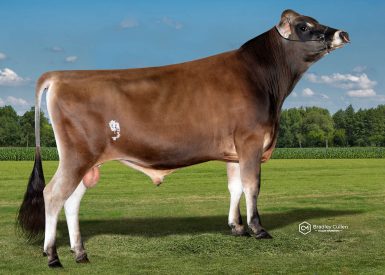
The 2022 Genetics Australia Jersey team is led by daughter-proven bulls from the number 1 BPI Jersey herd White Star Jerseys DOUGGAN 395 $BPI and DOBSON 358 $BPI. DOBSON also leads the Sustainability Index [SI] with an SI of 882 while DOBSON ranks third on 757 SI. At 33kgs Protein and +363 milk DOUGGAN is also a production and health traits specialist making him one of the most profitable bulls ever made available in Australia. He can also be used to advantage in crossbreeding programs as his lower stature and improvements to feet and legs, rumps and body traits make him ideal for use over Holsteins.
DOUGGAN and DOBSON are joined by INVINCIBLE 338 $BPI and ASKN 294 $BPI as the four leading Australian BPI Jersey daughter-proven bulls standing in Australia. INVINCIBLE at 110 for Overall Type also tops the Good Bulls Guide [GBG] for Type list while ASKN now has more than 230 milking daughters and at 115 for Longevity ABV is the highest Jersey bull available.
In the Australia Reds, ARBMCKEON is now the highest genomic bull closely followed by ARBCAESAR in 2nd and ARBPRIMESTAD P in 3rd position while ARBCYGNET is the highest Australian Red bull. We continue to invest in our red program and growing international awareness of the advantages of 3 x cross-breeding will see demand continue to grow for this profitable breed.
Mr Shelly said ‘Genetics Australia was committed to continuing to invest in genetics best suited to Australian farming systems for the betterment of our all our members and dairy producers. We look forward assisting you in bull selection, our goal remains to provide improved returns and ongoing development to your business via genetic improvement’.
The Genetics Australia Holstein, Jersey and Australia Red Sire Catalogues have been mailed to all farmers and together with more August ABV information is available at www.genaust.com.au
For More Information: Anthony Shelly 0408 529 410
Bryan is celebrating more ABV success with SUPERPOWER receiving his first daughter proven breeding value and shooting straight to the top as the number one Australian-standing daughter proven Holstein.
Marketed by Genetics Australia, Emu Banks SUPERPOWER is expected to live up to his name and deliver extremely profitable and robust cows with tremendous production and strength traits.
For Bryan and his wife Jo, it”s another in a long line of successes, including CHRISTMAS which topped the bull rankings seven years ago.
SUPERPOWER graduated to the Genetics Australia proven daughter team after the April 2022 ABV release with an impressive 454 BPI and 256 ASI, easily placing him into the top one per cent of bulls available and the highest new Australian bull. He is A22, an impressive +.56% for Protein and +.27% for Fat with positive a milk ABV.
But Genetics Australia”s Western Victorian Regional Sales Manager Rodney Brooks says it”s not just production where he excels; he is equally as impressive for health traits. ‘His 105 for Mastitis Resistance, 110 for Daughter Fertility and 102 for Calving Ease with a -4 for Gestation Length make him a Total Performance Sire and will ensure he is included in many breeding programs,’ he said.
His daughters are very black, of lower stature with a “no holes” type and mammary ABV. Semen is available as sexed or conventional.
The herd”s ongoing success – including being the second ranked Holstein herd in Australia after the April proof run, augers well for the farm”s first reduction sale with about 250 cows going under the hammer at Mortlake on June 1.
‘I don”t know the average BPI but they will be good commercial cows and mostly freshly calved from February through to June. Even my very top cows are not show cows; they”re commercial and every cow gets treated equally; no-one gets favours.’
Bryan and Jo sold their second farm at Glenfyne a couple of years ago and are already enjoying the lifestyle benefits since concentrating on their Terang property.
‘I”m not going to retire but I”m going from 1000 down to 700 and enjoy life a little bit more,’ he said.
Bryan recently went to Pakistan with Genetics Australia”s export manager Rob Derksen. ‘I want to do more of that,’ he said. ‘It worked really well. A lot of the farmers wanted to talk to another farmer.’
Bryan, who sells about 20 registered genomic Holstein bulls per year, has sold bulls to Genetics Australia since 2007, usually giving the company first choice.
CARTEL, a young genomic bull at TLG with a very good Type proof, is also from an Emu Banks home-bred family.
GENOMIC testing has revolutionised Chris Place’s dairy herd – and likely made it much more valuable.
Chris farms with his brother Peter and they’re part of a family dairying dynasty with six brothers on different farms in the Camperdown region.
Their objective is to have the best possible herd, with trouble-free high-production, longevity and self-replacement and genomic testing and using sexed semen has done the trick.
They have almost doubled their number of heifers born each year and halved their empty rate. Their herd ranking has gone from about 150 to the top 40, complete with a heifer in the national top 10, and they have a new income stream through beef sales.
The whole herd is now registered with Holstein Australia.
Chris was inspired to expand the use of genomic testing after participating in the Ginfo project and from discussions with his consultants at Genetics Australia and DataGene.
Ginfo is a large-scale genotyping project to provide genetic and performance information to increase the reliability of Australian Breeding Values (ABVs) and indices. It is a collaboration of DataGene, Dairy Australia, Holstein Australia, Jersey Australia and the Victorian government.
Like the Our Farm, Our Plan process used by Dairy Australia to help farmers identify long-term goals, improve business performance and manage volatility, Chris took it upon himself to do some forward thinking.
He now knows much more about his herd and is sure it’s better than ever, and he has the facts to back that claim.
Chris and Peter had some cows registered about 25 years ago and had used some sexed semen, but that has ramped up as they continue to develop the genetic merit of the herd.
Their meticulous record keeping helped when it came to using the new technology.
“Because we had very accurate records going back more than 50 years, they could take my DNA data and see how it correlates to my herd recording data and use the Ginfo data to see the different markers such as milk production and mastitis resistance,” he said.
They have been using sexed semen on maiden heifers for about seven years, concentrating on growing young stock well to maximise mating results, as well as ramping up use within the herd, and it has been a game changer. The valuable data from the genomic testing is used in selecting cows to breed from.
After joining maiden heifers to sexed semen, they have gone from getting 70-80 heifers a year to 140-150.
The figures support Chris’s theory.
“We were ranked about 150 in the top herds; suddenly we’ve jumped up to the top 40,” he said. “We’ve never been that high before and we also have one of our heifers in the top 10 of female Holsteins in the country.
“That’s all come from the genomic testing.”
Genetics Australia is investigating the potential of breeding from one of Chris’s heifers.
Jersey Australia general manager Glen Barrett said the April ABVs provided positive proof Australian Jersey genetics were bred to meet dairy farmer needs across the globe.
Jersey Australia’s Positive Selection list continues to grow. Bulls must be active genomic tested and have positive ABVs for Milk, Fat and Protein percentage, Overall Type, Mammary and Fertility.
In the latest release, 39 bulls met this standard with an average BPI of 302, providing farmers a wide range of bulls that meet key selection criteria and drive profitability.
While his proof has eased a little, Douggan retained the number one proven bull spot, shared with his Genetics Australia and Con and Michelle Glennen’s White Star Jerseys stablemate, Dobson, both on a BPI of 413.
Pickle was the number one genomic bull with a BPI of 420, bred by Luke and Mel Wallace at Wallacedale Jerseys in Poowong, Victoria, and also marketed by Genetics Australia.
Impeccable, marketed by AgriGene and bred by Kaarmona Jerseys at Kaarimba in northern Victoria, was the number two genomic bull with a BPI of 404.
White Star Jerseys, at Noorat in south-west Victoria, returned to the number one herd position with a BPI of 207, followed by Brookbora Jerseys (Tennyson, Victoria) at number two with a BPI of 202 and Rob and Kerrie Anderson’s Kings Ville Jerseys (Gippsland, Victoria) at three with a BPI of 178.
Con and Michelle Glennen said the top spot reflected their focus on continual improvement.
“We’re taking out at the bottom and breeding at the front; every cow has to justify her existence for being there,” Michelle said.
“We still aim to breed a well-engineered, milky, low cell count function animal.”
Con said they had “thrown the net a bit wider looking for more outcrosses”, with bulls from Denmark, New Zealand and the United States.
The herd was second in the previous proof run.
In the cow rankings, the top young heifer was Langdale Matt Naomi 2, bred and owned by Darien and Alex Mathews from Langdale Jerseys at Mardan, Victoria.
Top cow was #19735, an Aussigold daughter bred by Alan Burgess and recently purchased by Rohan and Graham Sprunt of Kaarmona Jerseys, with a BPI of 531.
Jersey Australia general manager Glen Barrett said the April ABVs provided positive proof Australian Jersey genetics were bred to meet dairy farmer needs across the globe.
Jersey Australia”s Positive Selection list continues to grow. Bulls must be active genomic tested and have positive ABVs for Milk, Fat and Protein percentage, Overall Type, Mammary and Fertility.
In the latest release, 39 bulls met this standard with an average BPI of 302, providing farmers a wide range of bulls that meet key selection criteria and drive profitability.
While his proof has eased a little, Douggan retained the number one proven bull spot, shared with his Genetics Australia and Con and Michelle Glennen”s White Star Jerseys stablemate, Dobson, both on a BPI of 413.
Pickle was the number one genomic bull with a BPI of 420, bred by Luke and Mel Wallace at Wallacedale Jerseys in Poowong, Victoria, and also marketed by Genetics Australia.
Impeccable, marketed by AgriGene and bred by Kaarmona Jerseys at Kaarimba in northern Victoria, was the number two genomic bull with a BPI of 404.
White Star Jerseys, at Noorat in south-west Victoria, returned to the number one herd position with a BPI of 207, followed by Brookbora Jerseys (Tennyson, Victoria) at number two with a BPI of 202 and Rob and Kerrie Anderson”s Kings Ville Jerseys (Gippsland, Victoria) at three with a BPI of 178.
Con and Michelle Glennen said the top spot reflected their focus on continual improvement.
‘We”re taking out at the bottom and breeding at the front; every cow has to justify her existence for being there,’ Michelle said.
‘We still aim to breed a well-engineered, milky, low cell count function animal.’
Con said they had ‘thrown the net a bit wider looking for more outcrosses’, with bulls from Denmark, New Zealand and the United States.
The herd was second in the previous proof run.
In the cow rankings, the top young heifer was Langdale Matt Naomi 2, bred and owned by Darien and Alex Mathews from Langdale Jerseys at Mardan, Victoria.
Top cow was #19735, an Aussigold daughter bred by Alan Burgess and recently purchased by Rohan and Graham Sprunt of Kaarmona Jerseys, with a BPI of 531.
GENOMIC testing has revolutionised Chris Place”s dairy herd – and likely made it much more valuable.
Chris farms with his brother Peter and they”re part of a family dairying dynasty with six brothers on different farms in the Camperdown region.
Their objective is to have the best possible herd, with trouble-free high-production, longevity and self-replacement and genomic testing and using sexed semen has done the trick.
They have almost doubled their number of heifers born each year and halved their empty rate. Their herd ranking has gone from about 150 to the top 40, complete with a heifer in the national top 10, and they have a new income stream through beef sales.
The whole herd is now registered with Holstein Australia.
Chris was inspired to expand the use of genomic testing after participating in the Ginfo project and from discussions with his consultants at Genetics Australia and DataGene.
Ginfo is a large-scale genotyping project to provide genetic and performance information to increase the reliability of Australian Breeding Values (ABVs) and indices. It is a collaboration of DataGene, Dairy Australia, Holstein Australia, Jersey Australia and the Victorian government.
Like the Our Farm, Our Plan process used by Dairy Australia to help farmers identify long-term goals, improve business performance and manage volatility, Chris took it upon himself to do some forward thinking.
He now knows much more about his herd and is sure it”s better than ever, and he has the facts to back that claim.
Chris and Peter had some cows registered about 25 years ago and had used some sexed semen, but that has ramped up as they continue to develop the genetic merit of the herd.
Their meticulous record keeping helped when it came to using the new technology.
‘Because we had very accurate records going back more than 50 years, they could take my DNA data and see how it correlates to my herd recording data and use the Ginfo data to see the different markers such as milk production and mastitis resistance,’ he said.
They have been using sexed semen on maiden heifers for about seven years, concentrating on growing young stock well to maximise mating results, as well as ramping up use within the herd, and it has been a game changer. The valuable data from the genomic testing is used in selecting cows to breed from.
After joining maiden heifers to sexed semen, they have gone from getting 70-80 heifers a year to 140-150.
The figures support Chris”s theory.
‘We were ranked about 150 in the top herds; suddenly we”ve jumped up to the top 40,’ he said. ‘We”ve never been that high before and we also have one of our heifers in the top 10 of female Holsteins in the country.
‘That”s all come from the genomic testing.’
Genetics Australia is investigating the potential of breeding from one of Chris”s heifers.
Katrina Galindo grew up with beef cows and horses and later fell in love with the dairy industry.
Now she’s getting to combine both dairy and beef with her interest in artificial breeding in her new role as Genetics Australia’s regional sales manager for Gippsland.
One of Katrina’s priorities will be building close connections with farmers, building on her strong track record in this field.
“I enjoy selling but I mostly like building relationships through account management,” she said. “I love going out on farms where you really get to know families.”
Warragul-based Katrina grew up on a beef farm and around horses and initially worked with racehorses after completing a Bachelor of Equine Science.
However, her interest in artificial breeding prompted a career change. “Racehorses don’t do artificial breeding so I crossed over and did A.I. courses and got into the dairy industry as a ruminant nutritionist, which I really enjoyed,” she said.
Katrina undertook extensive study in the dairy field, including courses in rearing healthy calves, artificial insemination and reproductive management, feeding pastures for profit, farm business fundamentals and advanced ruminant nutrition.
Her career change to dairy in 2015 proved to be a great success and Katrina has since held several roles across sales, accounts and farm management.
Her new role with Genetics Australia is a perfect fit. “Now I’m combining both my knowledge of artificial breeding technologies and my love of the dairy industry and love of animals of all shapes and sizes,” she said.
“I’m a bit sciency and the artificial breeding side of the business is really exciting because it opens up the world.”
Katrina now sees her future mostly in the dairy industry, and is excited about the opportunities offered in genetics.
“The dairy industry is definitely changing but that’s not a bad thing and it’s in a good position at the moment,” she said. “I definitely want to stay in the dairy industry. I moved out for six months and really missed it so I’m happy to be back.”
While she shifted to dairy for greater job opportunities, she won’t be ignoring beef in her new job.
“The genetics industry is also seeing growth in beef. Commercial beef herds are looking at AI which is exciting,” Katrina said.