A new genetic disorder was recently identified within the Holstein breed. Formerly called calf recumbency – has now been named Early Onset Muscle Weakness Syndrome (MW). Below, you will find questions and answers explaining MW and our approach to mitigating its impact.
Please note, this genetic disorder has proven more complex than other recent genetic defects and additional research and testing is being conducted. For further details, read this industry statement on recumbency in Holstein calves available on the Council on Dairy Cattle Breeding (CDCB) website. Also review this May 2023 statement from Holstein Association USA.
What is Early Onset Muscle Weakness Syndrome (MW) in Holstein calves?
MW is a genetic disorder that affects Holstein calves’ ability to stand. Calves affected by MW are unable to stand at birth or lose the ability to stand shortly after birth.
What is the frequency of MW in the Holstein population?
Currently, the population frequency is unclear; however, MW has been traced back to some influential Holstein bloodlines and is likely to be present in all A.I. breeding programs to some degree. In particular, influential bloodlines that are known to carry this genetic defect trace back to Roylane Socra Robust and his son Seagull-Bay Supersire (both are MW carriers). We can assume there will be more as further testing is conducted.
A gene test has been developed using research by scientists at Penn State University that can identify carrier animals, but a haplotype test is not yet available from CDCB.
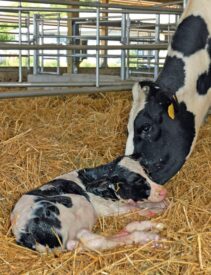
The newly identified genetic defect, originally called recumbency in Holstein calves, is characterized by the calf’s inability to stand at birth or the loss of the ability to stand shortly after birth.
How can I mitigate the impact of MW on my herd?
Where animals are ready to be joined that are sired by known carrier bulls, simply select a bull from the active list that are tested non carriers. If the heifers to be joined are not sired by carrier bulls or are sired by bulls of unknown status we suggest the genetic merit of the intended sire is considered and the bull used given the low percentage of bulls identified as carriers.
Our GENESCREEN™ mating program will be updated to prevent matings between known MW carriers. It is important to note, that there is currently no industry source file for MW status. As a result, we are unable provide certainty of when this tool will be available.
Where can I access MW test results on GENETICS AUSTRALIA bulls?
Below are the most recent test results on GA sires, as of September 2023. Use the link below to download a PDF file of active GA sires.
MW Test Results on Active Sires
How are the test results labeled?
The tested bulls have been grouped into three categories: Free, Carrier or Affected. The bulls listed as “N” are tested free of MW. Those labeled “Carrier” have tested heterozygous for MW, and those labeled “Affected” are considered homozygous for MW.
Note that this deviates from the historic understanding of genetics where a homozygous designation (Affected) is traditionally lethal. At this point, it is believed the affected individuals may have recovered from the genetic defect, but the reason is not yet fully understood.
Also note that consistent and concise labeling is being established across the industry to ensure MW is universally recognized. Once decided and available, we will add and update labeling across our Genetics Australia platforms.
What percentage of animals would result in a lethal outcome if random mating took place?
While we do not know exact details or prevalence in the population, we can provide an example based on a reasonable prevalence rate. If the prevalence rate is 10%, then the risk of a lethal outcome is 0.25% of randomly mated animals (see below).
- .10 x .10 = 0.01 (assuming a 10% prevalence chance for both dam and sire)
- 0.01 (above) x .25 (chance of a lethal if both carriers) = 0.0025
- 0.25% of randomly mated animals will result in a lethal outcome
If you have further questions, regarding the MW (or recumbency) genetic defect impacting Holstein calves, please reach out to your local Genetics Australia representative.